
Least Common Denominator Calculator
Quickly find the lowest common denominator for fractions, integers, and mixed numbers with our free Least Common Denominator (LCD) Calculator. Try it today!


Least Common Denominator (LCD)
LCD = 8
There was an error with your calculation.
Last updated: June 3, 2026
Table of Contents
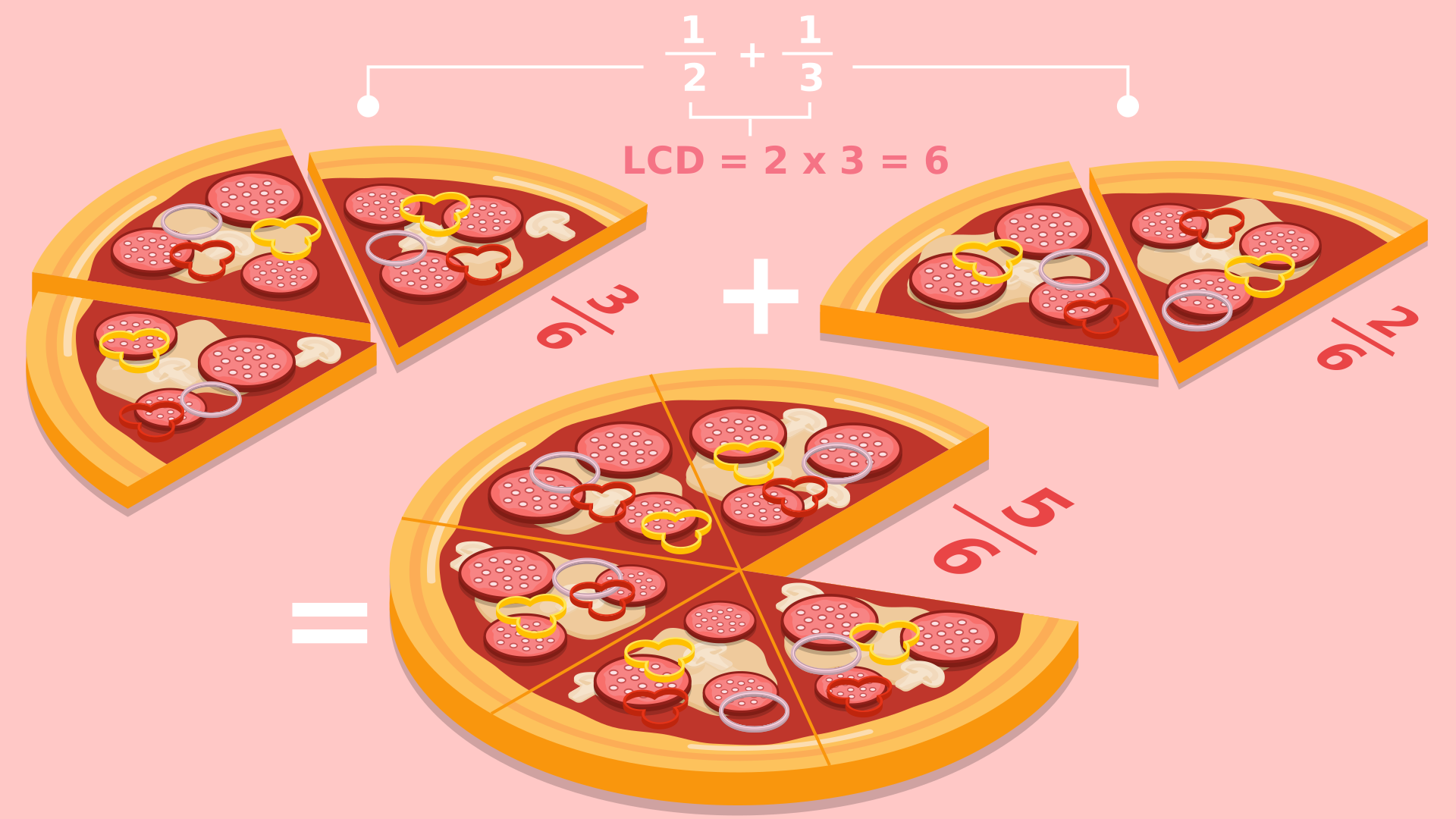
Our Least Common Denominator (LCD) Calculator quickly determines the lowest number that can be used as a shared denominator for a set of input values. Whether you are working with integers, fractions, or mixed numbers, this tool simplifies the process of finding the LCD in seconds.
Directions for use
To use the LCD calculator, simply enter your values separated by commas. The calculator accepts both positive and negative numbers. When entering a mixed number, be sure to separate the whole number from the fractional part with a single space (for example: \$5 \frac{1}{2}\$). Once you have entered your numbers, click "Calculate." The tool will instantly display the least common denominator alongside a detailed, step-by-step solution algorithm.
Definitions
The least common denominator (also known as the lowest common denominator) is the smallest number that can serve as a common denominator for a given set of fractions. Finding the LCD is a crucial step when you need to perform addition or subtraction operations with fractions or mixed numbers.
How to find the least common denominator
To manually find the LCD of a set of numbers, follow these straightforward steps:
- Convert all numbers into fractions.
- Find the least common multiple (LCM) of the denominators for all the fractions.
- The LCM of the denominators will become the LCD for your original fractions. Rewrite the original fractions using this LCD as the new denominator.
Positive values
For example, let’s find the LCD of the following numbers: 3, \$\frac{3}{8}\$, \$1 \frac{1}{2}\$, \$\frac{5}{4}\$. Following the steps of the algorithm above, we get:
- Converting all numbers into fractions:
- 3 = \$\frac{3}{1}\$
- \$\frac{3}{8}\$ = \$\frac{3}{8}\$
- \$1 \frac{1}{2}\$ = 1 + \$\frac{1}{2}\$ = \$\frac{2}{2}\$ + \$\frac{1}{2}\$ = \$\frac{3}{2}\$
- \$\frac{5}{4}\$ = \$\frac{5}{4}\$
- The fractions now have the following denominators: 1, 8, 2, and 4. Therefore, we need to find the LCM of 1, 2, 4, and 8. Let’s determine LCM (1, 2, 4, 8) by listing their multiples:
- Multiples of 1: 1, 2, 3, 4, 5, 6, 7, 8, 9, 10…
- Multiples of 2: 2, 4, 6, 8, 10, 12…
- Multiples of 4: 4, 8, 12, 16…
- Multiples of 8: 8, 16, 24
LCM (1, 2, 4, 8) = 8
- LCM (1, 2, 4, 8) = LCD (3, \$\frac{3}{8}\$, \$1 \frac{1}{2}\$, \$\frac{5}{4}\$) = 8.
Rewriting the original fractions, we get:
- 3 = \$\frac{3}{1}\$ = \$\frac{3 × 8}{1 × 8}\$ = \$\frac{24}{8}\$
- \$\frac{3}{8}\$ = \$\frac{3}{8}\$
- \$1 \frac{1}{2}\$ = \$\frac{3}{2}\$ = \$\frac{3 × 4}{2 × 4}\$ = \$\frac{12}{8}\$
- \$\frac{5}{4}\$ = \$\frac{5 × 2}{4 × 2}\$ = \$\frac{10}{8}\$
Negative values
The algorithm described above can also be used to find the LCD when one or more of the given values are negative. For instance, let’s find the LCD of (- 4, \$\frac{2}{3}\$):
- -4 = - \$\frac{4}{1}\$
- \$\frac{2}{3}\$ = \$\frac{2}{3}\$
- The fractions have the following denominators: 1 and 3. Therefore, we need to find the LCM of 1 and 3. Let’s determine LCM (1, 3) by listing their multiples:
- Multiples of 1: 1, 2, 3, 4, 5…
- Multiples of 3 = 3, 6, 9…
LCM (1, 3) = 3
- LCD (- \$\frac{4}{1}\$, \$\frac{2}{3}\$) = LCM (1, 3) = 3.
Rewriting the fractions with the new denominator, we get:
- -4 = - \$\frac{4}{1}\$ = - \$\frac{12}{3}\$
- \$\frac{2}{3}\$ = \$\frac{2}{3}\$
Calculation example
Cooking
Imagine you are baking a cake that requires the following ingredients:
- \$2 \frac{2}{3}\$ cups of flour,
- 2 cups of milk,
- 1 cup of sugar, and
- \$\frac{1}{2}\$ cup of melted butter.
The catch is that you only have one mixing bowl, which holds a total volume of \$6 \frac{1}{2}\$ cups. Will your bowl be large enough to fit all of these required ingredients?
Solution
To solve this real-world problem, we need to sum the volumes of all the ingredients and compare the total value with the maximum capacity of the mixing bowl.
The given volumes are:
- Flour – \$2 \frac{2}{3}\$ cups
- Milk – 2 cups
- Sugar – 1 cup
- Butter – \$\frac{1}{2}\$ cup
To add these volumes together, let’s first convert the given values into fractions with a common denominator, following the algorithm outlined earlier.
- Converting all values into fractions, we get:
- \$2 \frac{2}{3}\$ = 2 + \$\frac{2}{3}\$ = \$\frac{6}{3}\$ + \$\frac{2}{3}\$ = \$\frac{8}{3}\$
- 2 = \$\frac{2}{1}\$
- 1 = \$\frac{1}{1}\$
- \$\frac{1}{2}\$ = \$\frac{1}{2}\$
- The fractions now have the following denominators: 1, 2, and 3. Therefore, we need to find the LCM of 1, 2, and 3.
Let’s find LCM (1, 2, 3) by listing their multiples:
- Multiples of 1: 1, 2, 3, 4, 5, 6, 7, 8…
- Multiples of 2: 2, 4, 6, 8, 10…
- Multiples of 3: 3, 6, 9, 12…
LCM (1, 2, 3) = 6
- LCD (\$\frac{8}{3}\$, \$\frac{2}{1}\$, \$\frac{1}{1}\$, \$\frac{1}{2}\$) = LCM (1, 2, 3) = 6.
Rewriting the original fractions, we get:
- \$2 \frac{2}{3}\$ = \$\frac{8}{3}\$ = \$\frac{8 × 2}{3 × 2}\$ = \$\frac{16}{6}\$
- 2 = \$\frac{2}{1}\$ = \$\frac{2 × 6}{1 × 6}\$ = \$\frac{12}{6}\$
- 1 = \$\frac{1}{1}\$ = \$\frac{1 × 6}{1 × 6}\$ = \$\frac{6}{6}\$
- \$\frac{1}{2}\$ = \$\frac{1 × 3}{2 × 3}\$ = \$\frac{3}{6}\$
Now we can calculate the total volume of all ingredients:
Volume of ingredients = \$2 \frac{2}{3}\$ + 2 + 1 + \$\frac{1}{2}\$ = \$\frac{8}{3}\$ + \$\frac{2}{1}\$ + \$\frac{1}{1}\$ + \$\frac{1}{2}\$ = \$\frac{16}{6}\$ + \$\frac{12}{6}\$ + \$\frac{6}{6}\$ + \$\frac{3}{6}\$ = \$\frac{16 + 12 + 6 + 3}{6}\$ = \$\frac{37}{6}\$ = \$6 \frac{1}{6}\$
We know that the bowl's total volume is \$6 \frac{1}{2}\$ cups. Let’s compare our two values: \$6 \frac{1}{6}\$ and \$6 \frac{1}{2}\$. To do this accurately, we must rewrite them as fractions with a common denominator:
- Converting into fractions, we get:
- \$6 \frac{1}{6}\$ = \$\frac{37}{6}\$
- \$6 \frac{1}{2}\$ = \$\frac{13}{2}\$
- The fractions have the following denominators: 2 and 6. Therefore, we need to find the LCM of 2 and 6. Let’s find LCM (2, 6) by listing their multiples:
- Multiples of 2: 2, 4, 6, 8, 10…
- Multiples of 6: 6, 12, 18…
LCM (2, 6) = 6
- LCD (\$\frac{37}{6}\$, \$\frac{13}{2}\$) = LCM (2, 6) = 6. Rewriting the original fractions, we get:
- \$6 \frac{1}{6}\$ = \$\frac{37}{6}\$
- \$6 \frac{1}{2}\$ = \$\frac{13}{2}\$ = \$\frac{13 × 3}{2 × 3}\$ = \$\frac{39}{6}\$
Finally, we can see that the total volume of the ingredients is \$\frac{37}{6}\$ cups, and the total volume of the bowl is \$\frac{39}{6}\$ cups.
39 > 37, therefore, \$\frac{39}{6}\$ > \$\frac{37}{6}\$. This means that your mixing bowl will comfortably fit all the necessary ingredients, and you can start baking your cake!
Answer
The total volume of the ingredients can be expressed as \$\frac{37}{6}\$ cups, while the volume of the mixing bowl is \$\frac{39}{6}\$ cups. Therefore, the bowl will successfully fit all of the required ingredients.