
Decimal to Percent Calculator
Instantly convert decimals to percentages with our free Decimal to Percent Calculator. Get fast, accurate results and learn the conversion formula easily.


Percent
75%
There was an error with your calculation.
Last updated: June 3, 2026
Table of Contents
- Directions for Use
- Converting Decimals to Percentages
- Converting Percentages to Decimals
- Real-Life Application
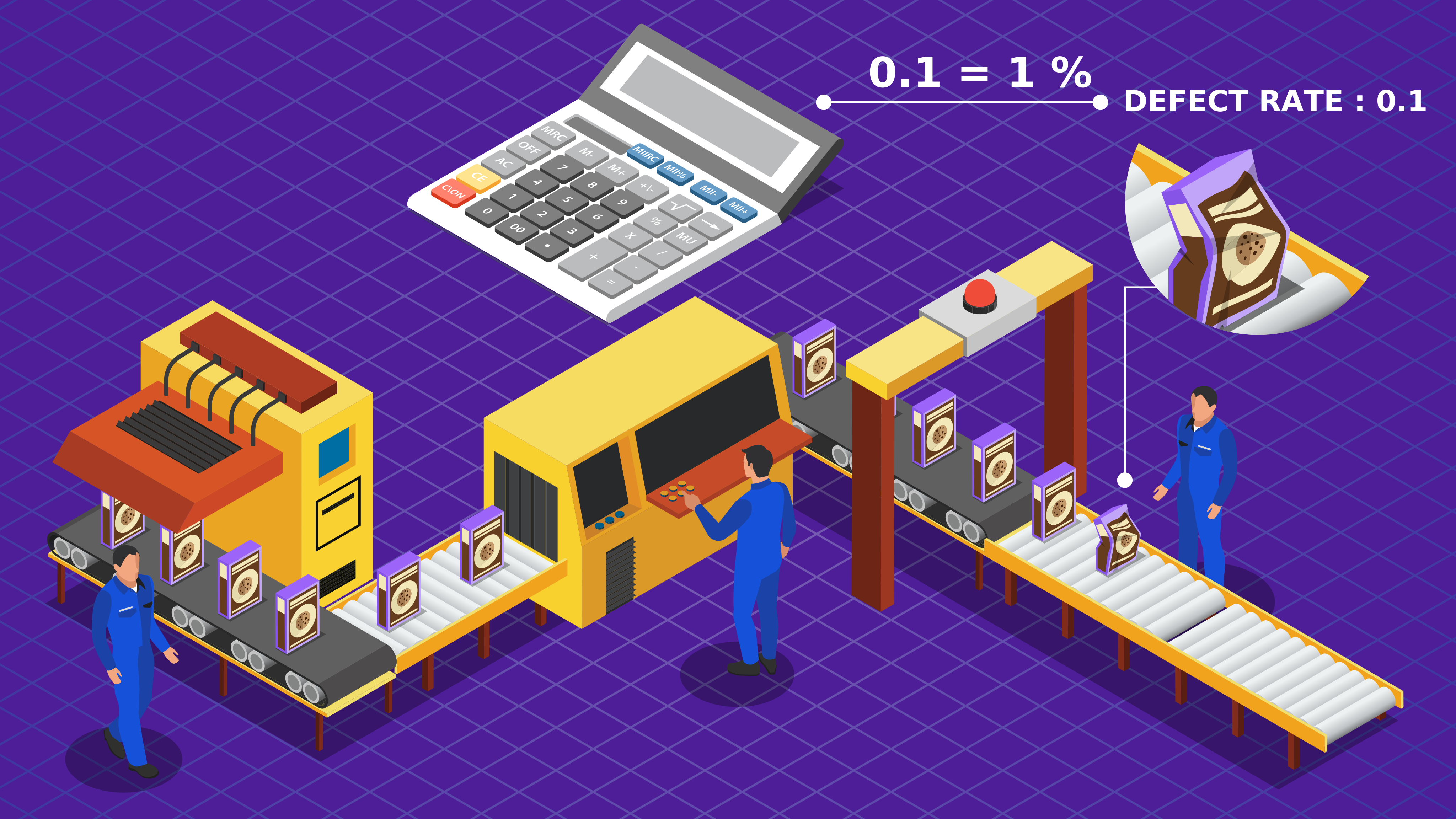
This decimal to percent calculator quickly and accurately converts decimal values into percentages based on the fundamental rule that 1 = 100%. While this conversion is typically used for values less than or equal to 1, our tool effortlessly handles numbers greater than 1 as well. Since any integer can be expressed as a decimal fraction, you can seamlessly convert whole numbers to percentages.
Directions for Use
To use this decimal to percent converter, simply enter your decimal number into the input field and click "Calculate." The tool will instantly perform the decimal to percentage conversion, providing both the final answer and a detailed, step-by-step solution.
Use a dot (.) to separate the whole number from the fractional part (e.g., 3.5, 0.0076, 7.89). The calculator accepts both positive and negative numbers as inputs. If you are converting a whole number, there is no need to add a decimal point—entering 3 is just as valid as entering 3.0.
Note: This specific calculator is designed exclusively to convert decimals to percentages. It does not support the conversion of simple fractions.
Converting Decimals to Percentages
Because the math relies on the core principle that 1 = 100%, converting a decimal to a percentage is as simple as multiplying the given number by 100%. Since multiplying a number by 1 does not change its mathematical value, multiplying by 100% (which equals 1) leaves the underlying value completely unchanged.
A faster, visual shortcut is to simply shift the decimal point two positions to the right. If you run out of digits while moving the decimal, just add a zero as a placeholder for each remaining shift. Finally, don't forget to append the % sign to your result!
Example 1
Convert 0.76 to a percentage.
Solution
Following the steps described above, to convert 0.76 into a percent, we simply multiply it by 100%:
0.76 × 100% = 76%
Using the visual shortcut, we move the decimal point two places to the right, which gives us 76. Then, we add the percentage symbol: 76%.
Answer
0.76 = 76%
Example 2
Convert 2.5 to a percentage.
Solution
Following the primary formula, to convert 2.5 to a percentage, we multiply it by 100%:
2.5 × 100% = 250%
Answer
2.5 = 250%
Notice that the final value exceeds 100%. If 100% represents one complete "whole," then any percentage above that indicates multiple "wholes." For instance, if a "whole" is a full glass of water, 100% is one full glass, while 50% means the glass is only half-full. Therefore, 200% represents two full glasses. In our example, 250% equates to exactly 2.5 glasses of water.
Converting Percentages to Decimals
To convert percentages back to decimals, simply reverse the process. This means you divide the percentage value by 100% to calculate the standard decimal format. Just as before, because 1 = 100%, dividing by 100% alters the format without changing the actual numerical value.
If you prefer the visual shortcut, you can convert percents to decimals by shifting the decimal point two positions to the left and removing the % sign. Once again, if you run out of digits while shifting the decimal point, just add a zero as a placeholder.
Example 3
Convert 67.5% to a decimal.
Solution
To convert 67.5% into a decimal format, we simply divide it by 100%:
67.5% / 100% = 0.675
Answer
67.5% = 0.675
Example 4
Convert 300% to a decimal.
Solution
To convert 300% into a decimal, we divide it by 100%:
300% / 100% = 3
Answer
300% = 3
Again, notice how the percentage exceeds 100%, translating to a decimal number greater than 1. If we imagine that 100% (the "whole") represents a single apple, then 300% simply corresponds to 3 apples.
Real-Life Application
Discounts in Shops
In retail stores, discounts are typically expressed as percentages. However, to calculate the final sale price, you must first perform a percent to decimal conversion. Let’s look at a practical example.
Sara is shopping for a dress. She finds one she loves with a 25% discount. The original price of the dress is $35. How much will the dress cost on sale?
Solution
To calculate the final price of the dress, we first need to determine the dollar equivalent of the 25% discount, and then subtract that amount from the original price. Here is the step-by-step solution:
- Find the value of the 25% discount by converting 25% to a decimal, then multiplying the original price by this new decimal value.
- Subtract the discount calculated in step 1 from the original price.
Following these steps, we get:
- Converting the 25% discount to a decimal:
25% = 25% / 100% = 0.25
Multiplying the original price by this decimal:
35 × 0.25 = 8.75
The dollar equivalent of the discount is $8.75
- Subtracting the discount amount from the original price:
$35 - $8.75 = $26.25
Answer
The dress currently costs $26.25 on sale.