
Percentage Change Calculator
Easily calculate the percentage increase or decrease between two values. Use our free Percentage Change Calculator to find the exact rate of change instantly.


Percentage Change from Number 1 to Number 2
110% increase
There was an error with your calculation.
Last updated: June 26, 2026
Table of Contents
- Directions for Use
- Percentage Change Calculation
- Percentage Increase or Decrease
- Using the Percentage Change Formula
- Calculation Examples
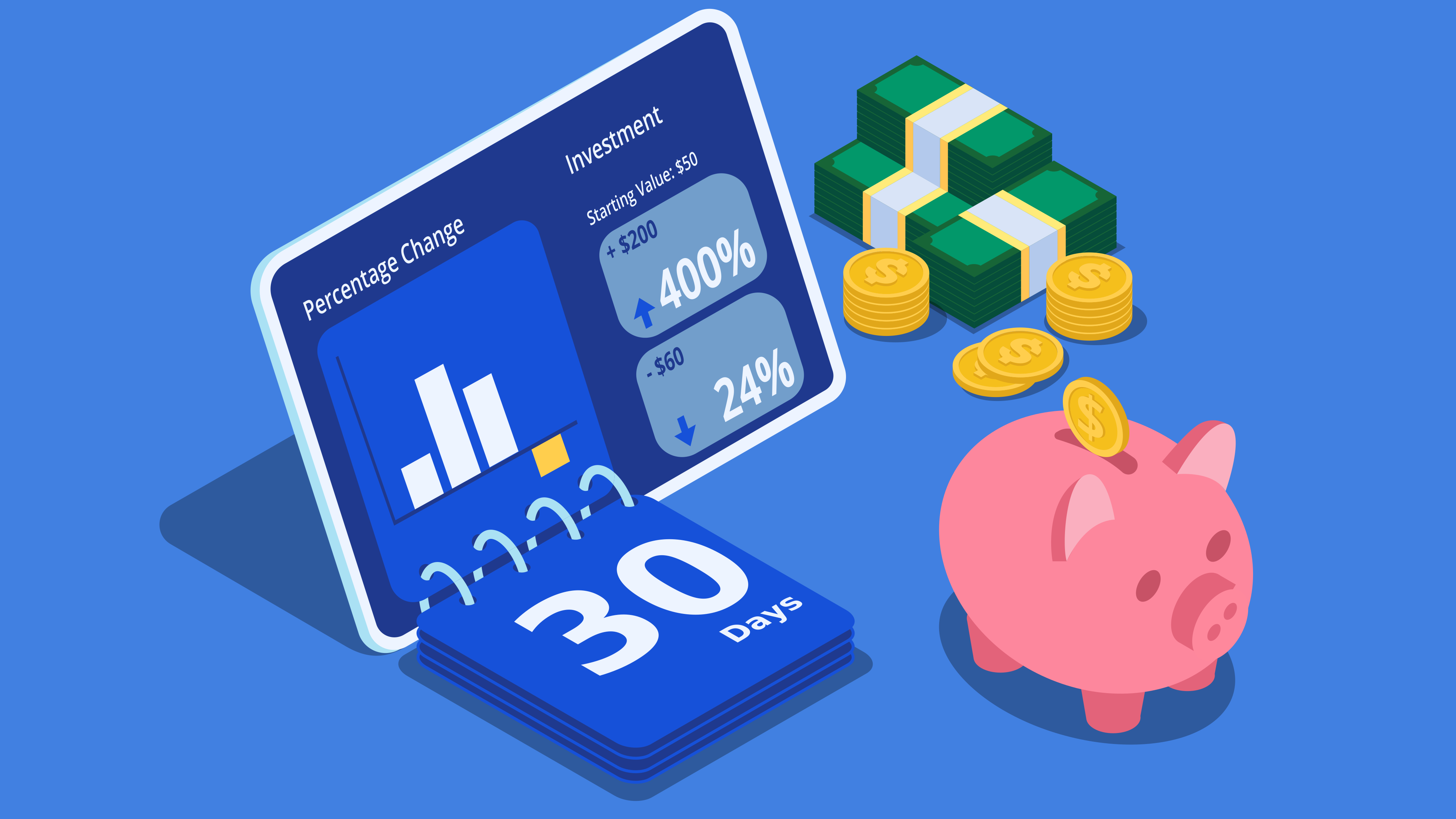
This versatile percentage change calculator easily determines the percentage shift from one value to another. Whether your input values are positive or negative, this tool provides accurate results instantly. You can also use it as a reliable rate of change calculator or a price change calculator to track financial metrics and data fluctuations.
Directions for Use
To calculate percentage change, simply enter Value 1 (V₁) and Value 2 (V₂) into their respective fields and click "Calculate." In this context, V₁ represents the starting (old) value, while V₂ represents the final (new) value. You can also press "Enter" on your keyboard to instantly run the calculation.
The calculator accepts both whole numbers and decimals as inputs. If you need to calculate the percentage change for fractions, you must first convert those fractions into decimals. Please note that if you enter a fraction directly into a field, the calculator will automatically disregard everything after the fraction bar. For example, entering "4/5" will be read simply as "4".
Percentage Change Calculation
Percentage Change Formula
Percentage change measures the shift from an initial value to a new value, expressed as a percentage. To manually calculate the percentage change from the old value (V₁) to the new value (V₂), follow these simple steps:
- Find the absolute change between the values:
Absolute Change = V₂ - V₁
- Find the relative change by dividing the absolute change by the absolute value (modulus) of the old value:
Relative Change = Absolute Change/ |V₁|
- Find the percentage change by multiplying the relative change by 100:
Percentage Change = Relative change × 100
We can also combine the steps above into a single, comprehensive percentage change formula:
Percentage Change = [(V₂ - V₁) / |V₁|] × 100
Percentage Increase or Decrease
The numerator in the formula above can be either positive or negative, depending on whether V₂ is larger or smaller than V₁. However, the denominator is always positive because it is represented by an absolute value (modulus). As a result, the final calculated percentage change can be either positive or negative.
When V₂ > V₁, the final value is greater than the initial value. This yields a positive result, indicating a percentage increase.
When V₂ < V₁, the final value is less than the initial value. This yields a negative result, indicating a percentage decrease.
Using the Percentage Change Formula
Let’s look at an example. Suppose we want to calculate the percentage change from 25 to 10 using the mathematical principles described above. In this scenario:
V₁ = 25, V₂ = 10, |V₁| = |25| = 25
Absolute Change = V₂ - V₁ = 10 – 25 = -15
Note that this value is negative.
Relative Change = Absolute Change/ |V₁| = -15/25 = -0.6
Percentage Change = Relative change × 100 = (-0.6) × 100 = -60%
Since the final percentage change is a negative value, this represents a percentage decrease.
Answer
60% decrease.
Calculation Examples
Example 1
Imagine you wanted to invest in gold and bought several ounces in June 2022, when the price was $1,836.57 per ounce. In July 2022, the price per ounce dropped to $1,732.74. What was the price change expressed as a percentage?
Solution
To find the percentage price change, we need to calculate the difference between the two prices. In this example, the starting value V₁ = 1836.57, the final value V₂ = 1732.74, |V₁| = |1836.57| = 1836.57.
Let’s calculate the percentage change based on our algorithm:
Absolute Change = V₂ - V₁ = 1732.74 - 1836.57 = −103.83
Relative Change = Absolute Change/ |V₁| = (−103.83)/ 1836.57 = −0.0565347
Percentage Change = Relative change × 100 = (−0.0565347) × 100 = −5.65347%
The percentage change in the price of gold per ounce between June and July 2022 was −5.65347%, signifying a 5.65347% decrease.
Answer
The price of gold per ounce decreased by 5.65347% in July 2022 compared to June 2022.
Example 2
In August 2022, the price of gold increased to $1,764.56. What is the price change in percent between July and August?
Solution
In this case, the starting value V₁ = 1732.74, the final value V₂ = 1764.56, |V₁| = |1732.74| = 1732.74.
Absolute Change = V₂ - V₁ = 1764.56 - 1732.74 = 31.82
Relative Change = Absolute Change/ |V₁| = 31.82/ 1732.74 = 0.018364
Percentage Change = Relative change × 100 = 0.018364 × 100 = 1.8364%
The percentage change in the price per ounce of gold between July and August 2022 was 1.8364%. This indicates a 1.8364% increase.
Answer
The price of an ounce of gold increased by 1.8364% between July and August 2022.
Please note that if the price in August returned exactly to its June value, the absolute value of the percentage change between July and August would still differ from the percentage change between June and July.
Remember that for the price change between June and July, we used the following values: the starting value V₁ = 1836.57, the final value V₂ = 1732.74, |V₁| = |1836.57| = 1836.57. This resulted in a percentage decrease of 5.65347%.
Example 3
Now imagine that in August, the price bounced back to the exact value it was in June. In this scenario, the values would be: V₁ = 1732.74, the final value
V₂ = 1836.57, |V₁| = |1732.74| = 1732.74
Solution
Let’s calculate the relevant figure using our percentage change formula:
Percentage Change = [(V₂ - V₁) / |V₁|] × 100 = ((1836.57 - 1732.74)) / |1732.74| × 100 = 103.83 / 1732.74 × 100 = 0.0599224 × 100 = 5.99224%
Answer
The percentage change in this case amounts to 5.99224%, representing a 5.99224% increase.
Finally, we can observe that even though the gold prices in June and August were identical, the percentage change values were entirely different. From June to July, the price decreased by 5.65347%, while from July to August, it increased by 5.99224%.
This occurs because percentage change is a relative metric calculated based on the starting value. Even though the absolute change in price (in dollars) was the same, the relative change—anchored to different starting values—produced a different result.