
Area Calculator
Easily calculate the area of rectangles, triangles, circles, and more. Use our free Area Calculator for fast, accurate geometry and square footage results!


| Result | |
|---|---|
| Square Meters | 80 m² |
| Square Footage | 861.112833 ft² |
| Square Inches | 124000.248 in² |
| Square Yards | 95.6792037 yd² |
| Acres | 0.019768413 ac |
| Hectares | 0.008 ha |
There was an error with your calculation.
Last updated: June 3, 2026
Table of Contents
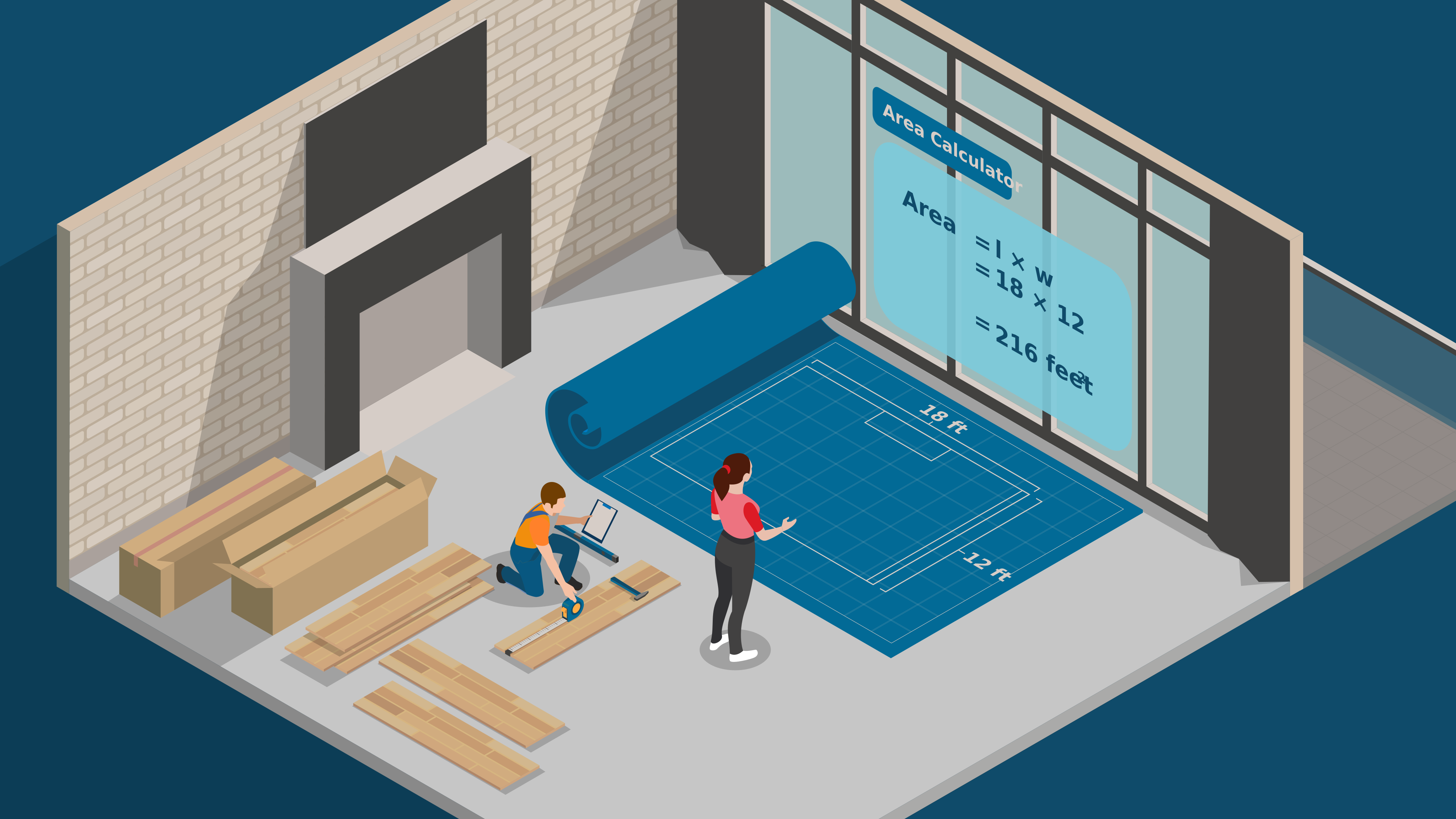
This versatile area calculator helps you easily find the surface area of the most common geometric shapes, including rectangles, triangles, trapezoids, circles, sectors, ellipses, and parallelograms. Whether you are working on a math problem, a DIY home project, or need a reliable land area calculator, this tool provides quick and accurate results.
Directions for use
To use this area finder, simply select the specific shape you want to calculate the area for and enter the known values into their respective fields. Select your preferred units of measurement from the drop-down menus, then click "Calculate." The tool will instantly compute the figure's total area and provide a step-by-step breakdown of the solution.
Please note: If you input values using different units, the final solution will be expressed in each respective unit. You can also click "Show results in other units" at the bottom of the results page to seamlessly convert your answer into whichever measurement unit you need.
Limitations on the input values
For all shape calculators, input values must be positive numbers (both integers and decimals). An input of 0 is also accepted.
Certain shapes have specific input requirements, which are outlined below.
Triangle
Following the triangle inequality theorem, the sum of any two side lengths must always be greater than the length of the third side.
Sector
The central angle value must fall between 0 and 360 degrees, or between 0 and 6.2831853071796 radians.
Please note that you cannot use the "pi" symbol (π) to enter angle values in radians; you must calculate the numerical radian equivalent first. For example, to enter a 45° angle in radians, perform this calculation first: 45° = π/4 = 0.785398 rad. You would then input 0.785398 as your angle value.
Formulas and calculation examples
Area represents the physical size of a surface. Mathematically, an area value indicates how many unit squares can fit perfectly within the boundaries of a given two-dimensional figure. The standard unit square, as defined by the International System of Units (SI), is the square meter. One square meter (1 m²) represents the area of a square with a side length of exactly 1 meter:

Rectangle
The area of a rectangle represents the total number of unit squares that can fit within its borders. For instance, you can determine the area of a rectangle measuring 3 meters by 2 meters by mentally dividing its surface into unit squares and counting them:

Area = 6 m²
The formula for calculating the area of a rectangle is written as:
Area = Width × Length
or
A = w × l
Where A is the area, w is the width, and l is the length of the rectangle.
Calculation example
Suppose you are renovating your house and want to install new tiles on the bathroom floor. If the bathroom is rectangular, with a length of 1.5 meters and a width of 2 meters, what is the total surface area you need to cover with tiles?
Solution
- Width = w = 2m
- Length = l = 1.5m
Use the rectangle area formula to find the surface area of the bathroom floor:
A = w × l = 1.5 × 2 = 3 m²
You will need enough tiles to cover an area of three square meters.
Triangle
While there are multiple ways to calculate the area of a triangle, this calculator utilizes Heron's formula (also known as the semi-perimeter formula):
$$A=\sqrt{s(s-a)(s-b)(s-c)}$$
Where A is the area of the triangle, a, b, and c are the side lengths, and s is the semi-perimeter of the triangle, calculated as follows:
s = (a + b + c)/2
Calculation example
John just inherited a triangular plot of land. The land survey shows the side lengths of his property are 45 meters, 27 meters, and 31 meters. What is the total land area John now owns?
Solution
- Side 1 = a = 45m
- Side 2 = b = 27m
- Side 3 = c = 31m
Let’s calculate the semi-perimeter first:
s = (a + b + c)/2 = (45 + 27 + 31)/2 = 103/2 = 51.5
Then, let’s use Heron’s formula to calculate the area:
$$A=\sqrt{s(s-a)(s-b)(s-c)} = \sqrt{51.5(51.5-45)(51.5-27)(51.5-31)} = \sqrt{51.5×6.5×24.5×20.5} = \sqrt{168128.1875} = 410$$
John owns exactly 410 m² of land.
Trapezoid
You can calculate the area of a trapezoid using the following formula:
A = 1/2 × (b₁ + b₂) × h
where b₁ and b₂ are the bases of the trapezoid (the two parallel sides), and h is its height.
Calculation example
Mary wants to refinish the top of her antique trapezoid-shaped table. The furniture restoration shop charges $150 per square meter of surface area. If the table's dimensions are b₁ = 2m, b₂ = 1.5m, and h = 1m, what is the total cost to refinish the table?
Solution
- b₁ = 2m
- b₂ = 1.5m
- h = 1m
Let's first calculate the surface area of the table using the trapezoid area formula:
A = 1/2 × (b₁ + b₂) × h = 1/2 × (2 + 1.5) × 1 = 1/2 × 3.5 × 1 = 1.75
The surface of Mary's table is 1.75 m². To calculate the total price, we simply multiply the surface area by the restoration price per square meter:
Total price = A × price per m² = 1.75 × 150 = 262.5
Mary will have to pay $262.5 to beautifully refinish her table.
Circle
To find the area of a circle, use this standard formula:
A = π × r²
where π ≈ 3.1415926, and r is the radius of the circle.
Calculation example
A standard lawn sprinkler can spray water outward to a maximum radius of 5 meters. Is a single sprinkler sufficient to cover a circular lawn measuring 60 m²?
Solution
The lawn sprinkler rotates continuously, covering a distance of 5m in every direction.
r = 5m
Let’s calculate the maximum lawn area covered by the sprinkler:
A = π × r² = 3.1415926 × 5² = 3.1415926 × 25 ≈ 78.5
The lawn sprinkler covers an area of roughly 78.5 m². Therefore, one sprinkler will be more than enough to water a 60 m² lawn.
Sector
When calculating the area of a circular sector, the formula depends on whether the central angle is measured in degrees or radians. If the defining angle of the sector is expressed in degrees, use this formula:
A = (angle/360) × π × r²
Where angle is the defining central angle of the sector, r is the radius, and π ≈ 3.1415926.
If the sector is defined by an angle measured in radians, the surface area can be calculated as follows:
A = (angle/2) × r²
where angle is the defining angle of the sector, and r is the radius.
Ellipse
Determine the surface area of an ellipse by applying the following formula:
A = π × a × b
where π ≈ 3.1415926, a is half of the larger axis (semi-major axis), and b is half of the smaller axis (semi-minor axis) of the ellipse.
Parallelogram
To calculate the surface area of a parallelogram, use this straightforward formula:
A = b × h
where b is the base length of the parallelogram, and h is its vertical height.