
Kinetic Energy Calculator
Instantly calculate kinetic energy, mass, or velocity using the KE = 1/2 mv² formula. Fast, free, and accurate Kinetic Energy Calculator for physics problems.


There was an error with your calculation.
Last updated: June 16, 2026
Table of Contents
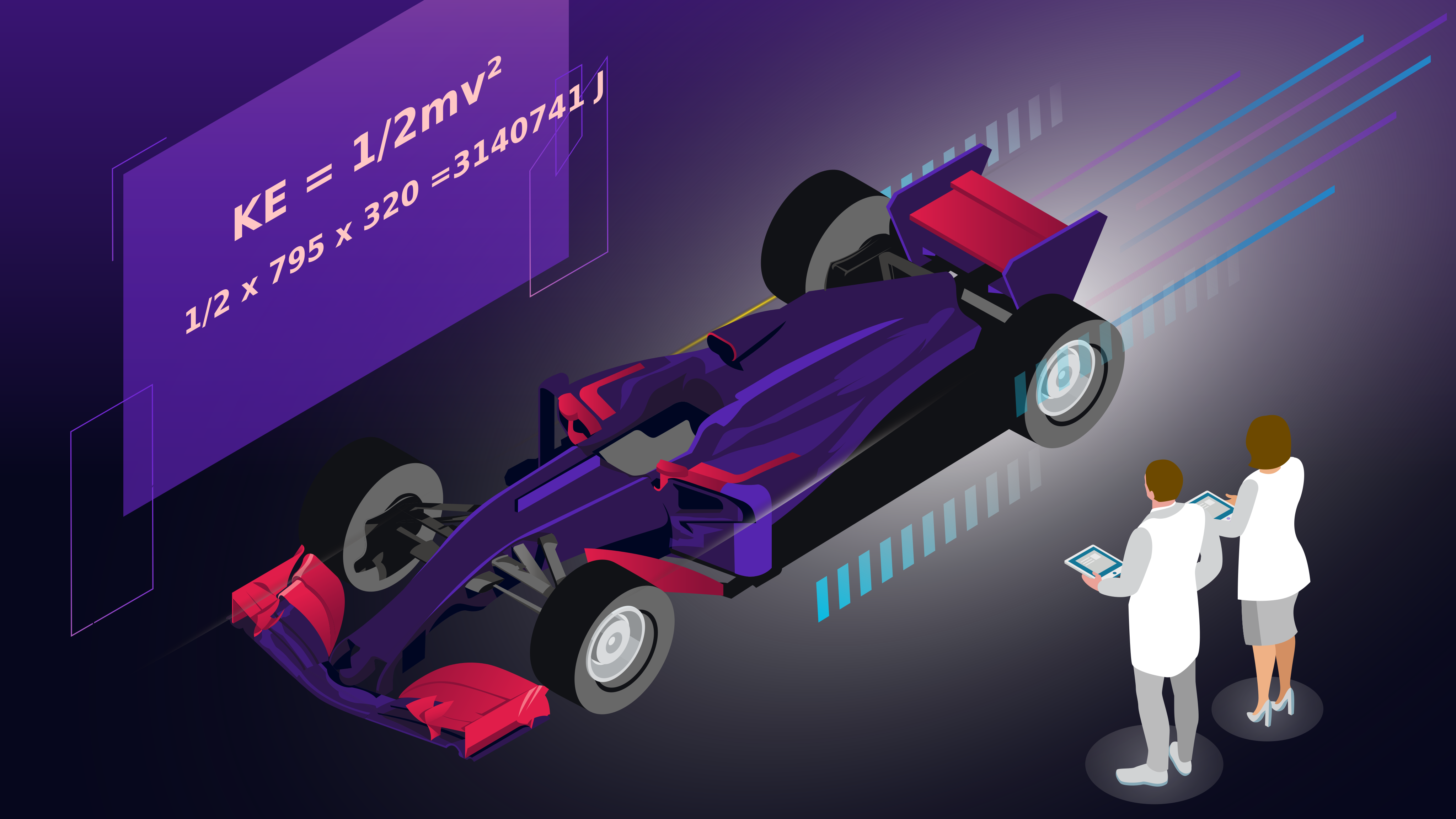
Our kinetic energy calculator helps you quickly determine the missing variable in the kinetic energy equation. By simply inputting two known values, the tool applies the standard kinetic energy formula, KE = 1/2 mv²—where KE stands for kinetic energy, m is the object's mass, and v is its velocity.
To use the tool, identify your known and unknown variables. For instance, if you know an object's mass and velocity, enter these values into the calculator. It will instantly solve for the unknown variable by applying the kinetic energy equation.
This versatile energy calculator supports a wide range of standard and imperial units: Joules (J), Megajoules (MJ), British Thermal Units (BTU), and calories for energy; kilograms (kg), grams (g), ounces (oz), and pounds (lb) for mass; and meters per second (m/s), kilometers per hour (km/h), feet per second (ft/s), and miles per hour (mph) for speed.
You can seamlessly switch between any of these metrics, and the kinetic energy formula calculator will perform real-time unit conversions. This flexibility makes the KE calculator perfect for international physics problems, mechanical engineering tasks, and a wide variety of everyday science applications.
Understanding Kinetic Energy
Have you ever wondered what powers a baseball flying through the air or a car speeding down the highway? The answer lies in kinetic energy—one of the most fascinating and fundamental principles of physics.
At its core, kinetic energy is the energy an object possesses due to its motion. It is formally defined as the exact amount of work required to accelerate a body of a given mass from a state of rest to its current velocity. Because it is proportional to the object's mass and the square of its speed, the faster an object moves, the more kinetic energy it carries. Conversely, kinetic energy also dictates the exact amount of work required to bring that moving body back to a complete stop.
The concept of kinetic energy was first introduced to modern science by French mathematician and physicist Gaspard-Gustave de Coriolis in the 1820s, and it was later popularized by Scottish engineer and physicist William John Macquorn Rankine in the 1850s.
Etymologically, the term originates from the ancient Greek word "kinesis," which translates simply to "motion."
A key characteristic of kinetic energy is that it is a scalar quantity—meaning it has magnitude but no specific direction. This mathematically distinguishes it from vector quantities, such as force or velocity, which rely on both a magnitude and a definitive direction.
The total amount of kinetic energy depends directly on the body's mass (m) and velocity (v). In the International System of Units (SI), kinetic energy is measured in Joules (J), though it can also be expressed in kilojoules (kJ) or megajoules (MJ).
You can calculate kinetic energy for moving objects of any size, from microscopic particles to massive planets. Because the kinetic energy of subatomic particles moving at extreme speeds can be difficult to measure in standard joules, scientists often use specialized alternative units like electronvolts (eV) or gigaelectronvolts (GeV).
The universally accepted formula for calculating kinetic energy is:
KE = 1/2 mv²
where m is the object's mass and v is its velocity.
Mass and velocity affect kinetic energy differently. While a more massive object will naturally carry more kinetic energy than a lighter object moving at the exact same speed, velocity has a much more dramatic, exponential impact.
Because velocity is squared in the equation, if the speed is doubled, the kinetic energy quadruples. Tripling the speed increases the kinetic energy by a factor of nine. Quadrupling the speed multiplies the total energy by sixteen.
This exponential relationship explains why a tiny bullet fired from a rifle, traveling at immense speed, carries enough kinetic energy to penetrate solid objects. It is also why a small bird in the air can cause severe damage to a massive commercial airplane mid-flight—the kinetic energy derived from the square of the impact velocity is staggering.
Finally, kinetic energy is not fixed; it easily converts into other forms of energy, such as thermal or potential energy. For example, when a moving vehicle slams its brakes to a stop, its kinetic energy transforms rapidly into thermal energy (heat) through friction.
Kinetic Energy Applications
We apply the principles of kinetic energy across countless industries and scientific fields. In mechanical engineering, for instance, kinetic energy calculations are vital for designing heavy machinery and evaluating the energy requirements of moving parts. In the automotive industry, engineers calculate the kinetic energy necessary to drive a car at specific speeds. Crucially, understanding how much energy must be dissipated during a collision allows designers to create highly resilient vehicle frames and life-saving crumple zones.
In electrical engineering, professionals evaluate the kinetic energy of moving electrons to accurately predict the behavior of complex electrical circuits and advanced hardware.
Similarly, aerospace engineering heavily relies on kinetic energy calculations. Aerospace designers must precisely determine the massive kinetic forces acting on aircraft during flight to engineer airframes capable of withstanding intense aerodynamic stress.
Knowledge of kinetic energy is also foundational in ballistics. It allows experts to calculate the impact force of moving projectiles, helping them accurately predict the trajectory, speed, and maximum range of everything from bullets to rockets.
In the realm of sports science, calculating the kinetic energy of moving objects—like a tennis ball or a golf ball—allows manufacturers to dramatically optimize sports equipment. By understanding impact forces, engineers can create high-performance tennis rackets, baseball bats, and golf clubs that maximize player efficiency.
Finally, kinetic energy calculations are at the absolute heart of renewable power generation. The wind and hydroelectric industries rely entirely on this data to design highly efficient turbines capable of converting the raw kinetic energy of moving air and water streams into sustainable electricity.
Kinetic Energy Formula Examples
Let's look at some practical examples of how to calculate kinetic energy in everyday scenarios.
Example 1
Imagine a car with a mass of 2,000 kg traveling down the highway at 60 miles per hour. To find its kinetic energy, we apply the standard formula: KE = 1/2 mv². Before solving, we must first convert the velocity from miles per hour into meters per second.
60 mi/h = 60 × 0.44704 = 26.8224 m/s
Now, by substituting these standard values into the equation, we get:
KE = 0.5 × 2000 × 26.8224² = 1000 × 719.44114176 = 719441.14176 J
The kinetic energy of the speeding car in our example is roughly 719,441 Joules.
By thoroughly understanding these immense energy values, automotive engineers can design vehicles that better withstand the chaotic forces of motion. A vehicle's kinetic energy dictates exactly how much force will act upon it during a sudden collision.
Engineers use this crucial data to construct reinforced structural frames and advanced safety systems—such as rapidly deploying airbags and precisely engineered crumple zones. These features safely dissipate the destructive energy of a crash, significantly reducing the risk of passenger injury. Furthermore, this data drives the development of active safety technologies like automatic emergency braking, which bleed off kinetic energy to help prevent a collision altogether.
Example 2
We can also use our kinetic energy calculator to analyze moving sports objects, which is critical for optimizing equipment design and predicting in-play physics.
Consider a baseball with a mass of 0.15 kg traveling at a speed of 20 m/s. To calculate the ball's kinetic energy, we simply plug the mass and velocity into the formula: KE = 1/2 mv². Substituting the values, we get:
KE = 0.5 × 0.15 × 20² = 0.5 × 0.15 × 400 = 30 J
The kinetic energy of the moving ball is exactly 30 Joules.
Understanding this value helps designers determine the sheer forces acting on the equipment upon impact. Armed with this knowledge, sports engineers can refine the material composites and structural designs of tennis rackets, baseball bats, and hockey sticks so they better withstand high-impact forces while delivering peak performance.
For instance, knowing a tennis ball's typical kinetic energy allows racket designers to maximize power return on a swing. Similarly, golf club manufacturers use impact data to craft specialized putters and drivers that maximize a golfer's overall range and precision.
Conclusion
Our online Kinetic Energy Calculator is an incredibly powerful, time-saving tool designed to help you quickly master the principles of motion. By automating the kinetic energy formula, it effortlessly predicts the behavior of moving objects, making it an invaluable resource for designing machines, planning structures, and evaluating high-speed physics.
Whether you are a physics student tackling tough homework equations, a professional engineer optimizing a complex project, or simply a science enthusiast curious about the fundamental laws of the universe, this calculator provides instant, highly accurate insights. Bookmark our tool today to streamline your calculations and deepen your understanding of kinetic energy.