
Gas Cost Calculator
Plan your road trip with our free Gas Cost Calculator. Quickly estimate fuel expenses based on distance, MPG, and gas prices to perfectly budget your travel.


| Consumption | Consumed | Cost |
|---|---|---|
| 5 mpg | 64 gal | $288.00 |
| 10 mpg | 32 gal | $144.00 |
| 20 mpg | 16 gal | $72.00 |
| 30 mpg | 10.7 gal | $48.00 |
| 40 mpg | 8 gal | $36.00 |
| 50 mpg | 6.4 gal | $28.80 |
| 60 mpg | 5.3 gal | $24.00 |
There was an error with your calculation.
Last updated: June 3, 2026
Table of Contents
- Use public transit instead of driving yourself
- Carpool
- Invest in a car that is more environmentally friendly
- Tune-up the engine
- Check tires
- Use the proper engine oil
- Make sure you plan your journey well
- Factors influencing the price of fuel
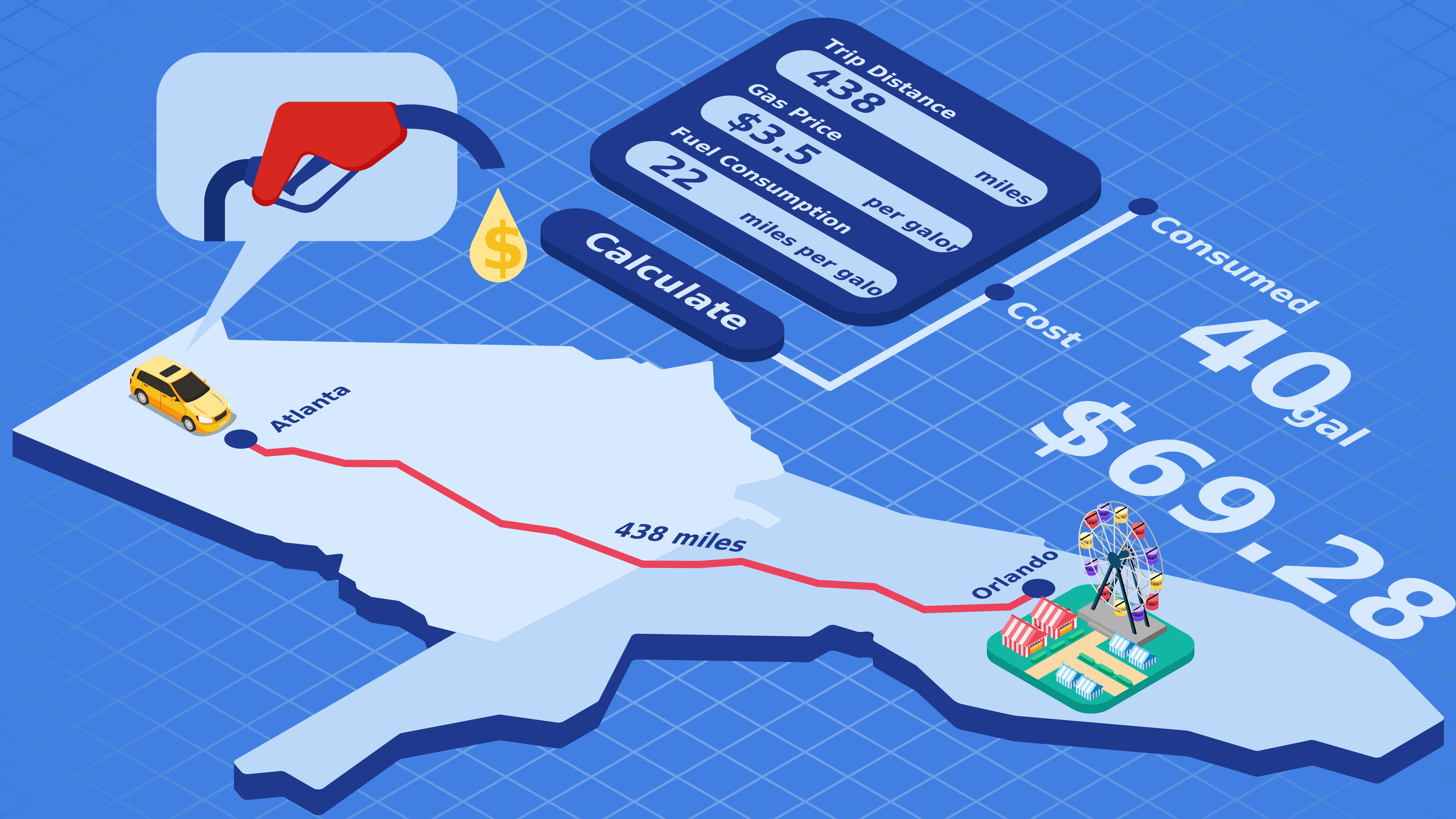
Use our comprehensive gas cost calculator to accurately forecast your trip's fuel expenses based on journey distance, vehicle fuel economy, and current gas prices in various units.
While gas prices constantly fluctuate, fuel remains a major expense for most drivers. According to the American Automobile Association (AAA), the average American motorist spends around $3,000 annually on gasoline. If you are looking to reduce your travel expenses, below is a list of highly effective, practical strategies to maximize your fuel efficiency and save money on gas.
Use public transit instead of driving yourself
In many areas, free or low-cost public transit is readily available. Whenever possible, leaving your car at home and utilizing buses, trains, or trolleys is an excellent way to eliminate gas costs entirely.
Because mass transit relies on a shared, communal model, the per-passenger fuel cost is significantly lower than if everyone drove their own vehicles. When you factor in the additional costs of vehicle ownership, maintenance, and insurance, public transportation becomes an even more attractive way to cut down your monthly travel budget.
Carpool
Carpooling allows multiple passengers heading to the same destination to share a single vehicle. Coordinating a ride-share is far more fuel-efficient than several individuals driving separate cars along the exact same route, instantly slashing your commute's fuel costs while reducing overall traffic congestion.
Invest in a car that is more environmentally friendly
The size and engine of your vehicle play a massive role in your overall gasoline costs. For instance, a lightweight, compact sedan will cost about half as much to fuel as a heavy, full-size SUV. Avoid paying for an eight-cylinder engine if a four-cylinder model meets your daily driving needs. Even if you occasionally haul heavier loads, the constant, everyday expense of fueling a larger engine quickly adds up to a substantially higher annual gas bill.
Tune-up the engine
A well-maintained, properly tuned engine optimizes power output while significantly improving fuel economy. Simply repairing a vehicle that is noticeably out of tune or has recently failed an emissions test can boost your gas mileage by an average of 4%. Furthermore, fixing a critical maintenance issue—such as replacing a faulty oxygen sensor—can dramatically increase your fuel efficiency by up to 40%.
Check tires
Regularly checking your tire pressure is essential for maximizing vehicle performance, ensuring safety, and improving gas mileage. Properly inflated tires can boost your vehicle's fuel efficiency by up to 3%. Keep in mind that tires naturally lose about 1 PSI (pound per square inch) of pressure per month. Tire pressure is also highly sensitive to temperature fluctuations, dropping in colder conditions as the air inside contracts.
To ensure maximum accuracy, check your tire pressure when the tires are cold—ideally once a week, but at least once a month. This simple maintenance routine not only aids in fuel conservation but also promotes even tread wear, extending the lifespan of your tires.
While most gas stations offer air compressors, their built-in gauges are often poorly calibrated and inaccurate. After inflating your tires, always verify the pressure using a high-quality, reliable tire gauge. Remember that the inflation levels recommended by your vehicle's manufacturer apply specifically to cold tires. If you need to inflate your tires after you have already been driving, a general rule of thumb is to add an extra 3 PSI to compensate for the heat-induced pressure expansion.
Never rely on the "maximum pressure" printed on the tire's sidewall. This figure indicates the absolute maximum pressure the tire can safely hold, not the optimal driving pressure. Always follow your vehicle manufacturer's recommended tire pressure settings for the best blend of safety and fuel efficiency.
Use the proper engine oil
Sticking to your manufacturer’s recommended motor oil grade can yield a 1% to 2% improvement in gas mileage. Conversely, using the wrong oil can negatively impact your engine's efficiency. For example, using 10W-30 motor oil in an engine designed for 5W-30 will significantly lower your gas mileage.
Similarly, using 5W-30 in an engine built for 5W-20 can reduce your fuel economy by 1% to 2%. Look for the API (American Petroleum Institute) performance symbol; motor oil marked as "Energy Conserving" contains specialized friction-reducing additives that help lower fuel consumption.
Make sure you plan your journey well
Driving a shorter distance is, naturally, the most direct way to save money on gas.
Before you hit the road, take time to map out your trip. Today’s GPS and route-planning apps make it incredibly easy to find the most direct path with the fewest detours. You can also use live traffic data to avoid congested areas and stop-and-go traffic, which notoriously drains the gas tank. When practical, choose highways over local city streets. The steady, consistent speeds maintained on highways help engines operate at peak fuel efficiency.
If you are driving in a busy city, try to park in a central location and walk or take public transit between your appointments. Idling in heavy urban traffic severely reduces your gas mileage. By parking once, you will also save the extra fuel that would otherwise be wasted circling for parking spots and constantly pulling in and out of lots.
Factors influencing the price of fuel
Involvement of the state
Gasoline taxes heavily influence the final price consumers pay, varying significantly between different governmental jurisdictions. Conversely, governments may offer financial assistance (subsidies) to specific energy sectors to stimulate economic activity. Heavily subsidized fuel sources typically result in lower costs for the end consumer.
Capital markets
The global price of crude oil is in a constant state of flux. The most commonly cited benchmarks, Brent Crude and West Texas Intermediate (WTI), are priced in US dollars per barrel. Because crude oil is the primary ingredient in gasoline, any variation in global oil commodity markets has an immediate and significant impact on retail gas prices.
Politics
Global events, political structures, regime changes, and individual policymakers all impact fuel costs. Nations may enter trade alliances or experience conflicts over natural resources, both of which can restrict supply and drive up gas prices. Domestic political shifts—such as transitioning from an administration that actively subsidizes fossil fuels to one focused on climate change initiatives—can also directly influence the cost of fuel for consumers.
Geographical location
Crude oil is abundant in certain regions of the world and entirely absent in others. Consumers living in areas with plentiful, easily accessible oil supplies naturally benefit from lower gasoline prices. Conversely, fuel can become prohibitively expensive in remote areas or island nations (such as the Pacific Islands) that lack a reliable domestic oil supply and require complex, costly shipping logistics.
Disasters caused by natural causes, such as bad weather
Natural disasters like earthquakes, tsunamis, hurricanes, and severe floods can severely disrupt oil extraction, refinery operations, and supply chain logistics, drastically affecting fuel prices.
For instance, tropical storms and earthquakes frequently force oil refineries to shut down, causing a sudden spike in gasoline costs. Similarly, extreme winter weather and heavy snowfall can close major highways, making the transportation of resources highly challenging and driving up local prices at the pump.